



Preconstruction takes 52% longer than the timelines teams commit to upfront.
The reason, as Peter Sosnowski puts it, is that "everything breaks at a connection" — and preconstruction is almost nothing but connections.
Owners think in proformas. Designers don't have budget context. Estimators don't have drawings. And cost data lives in shared drives, desktop tools, and spreadsheets that don't talk to each other.
Three construction tech giants, Dustin DeVan, Co-Founder & CEO of Ediphi, Peter Sosnowski, CEO & Founder of Pax Engineering, and Trey Darnell, Director of Sales at Ediphi, diagnose the biggest friction points in preconstruction.
The result is 5 clear and proven ways you can shorten preconstruction and get to the money faster.
Keep reading or — if you prefer to watch instead — here’s the full recording.
Why does preconstruction take so long to begin with?
Under the traditional model, design has to reach a certain level of completeness before estimating begins — and estimating has to finish before the next design phase starts.
The result is what Peter calls "two steps forward, one step back all the time."
A design team works for three to four months. An estimator prices it. The number is too high. The team redesigns. The estimator reprices. Meanwhile the estimate from the last milestone gets completely scrapped because there's no infrastructure to carry it forward.
Dustin says what every estimator is thinking, "Why did we just go from this set of documents to a whole new set of documents and now I have to start with completely new quantities?”
This is the status quo. Here's how to change it.
Tip #1: Price requirements, not drawings
You don't need complete drawings to have a real conversation; all you need are defined requirements.
Peter shared an example from a large tech firm electrification program in Silicon Valley; 70 buildings that all needed to go from fossil fuels to electricity.
Rather than designing each one before estimating, the team created a lightweight "basis of design" for each building and estimated all 70 simultaneously from those alone.
"The owner looked at it and made quick decisions because he knew what was needed on the design side and how much it would cost. Those projects were feasible and they moved on to the next phase quickly,” he says.
That's the model.
As Dustin put it: "You can price options based on just requirements. You don't need heavy designs at the conceptual phase."
Recommended reading: The Future of Preconstruction Starts with Cost, Not Design
Tip #2: Get your data out of files and folders
In a live poll during the webinar, nearly 40% of attendees said their preconstruction data lives primarily in shared drives and folders. Another 33% said they're spread across multiple estimating tools. Less than a handful said their data lived in a single, structured system.
That's the problem.
"Desktop tools prevent collaboration by definition. You launch your laptop, you open your estimate — if you're the only one in that file, it's a disconnected effort.” — Dustin DeVan, CEO at Ediphi
The deeper issue, even, is connecting institutional knowledge and data to your current projects.
Peter described a years-long effort at his former GC to build a historical cost database spanning 40 years of completed projects. The result was valuable, but it still didn't talk to their detailed estimating tool.
Where Ediphi comes in: Ediphi's Unit Price Catalog (UPC) is what Dustin calls "the nucleus of the atom" — a centralized, cloud-based cost database that lives inside the estimating tool, not outside it. Estimators can see regional cost differences, pull historical pricing on any line item with a right-click, and access that data in context — not as an after-the-fact report.
"This is a killer onboarding tool," Trey noted. "How do you take institutional knowledge and put it in the system and bring younger folks up to speed? This is how."
Tip #3: Build estimates parametrically and programmatically
There’s a gap between how owners think and how GCs estimate.
Owners think in programs like units, room types, cost per key. "When you build your proforma [as an owner], you're building to generate profit," Peter explained. GCs, meanwhile, take off drawings and sum unit rates.
Parametric estimating introduces structure, rules, and logic, so data can be viewed and manipulated in a variety of different ways for a variety of different conversations.
For example, instead of inputting “150 lavatory fixtures”, you’d define: “50 apartment units × 1 bathroom per unit × 3 fixtures per bathroom”. Now, your estimate is dynamic. If the project changes or a stakeholder wants to see a different input, you can update one number and the rest of the estimate responds.
Pro tip: Ediphi’s Area Sheet is the foundation of parametric estimating (and a great place to start!)
Tip #4: Connect value engineering to estimating
Someone throws out a ROM.
"Let's cut the parking garage!” or "Switch carpet to laminate!".
Then, someone has to manually go back into the estimate to figure out what it actually affects.
"You agree on a ROM, then you go back into the estimate and realize it affects 15 other things," Dustin said. "Or then you get the drawings and your ROM wasn't right."
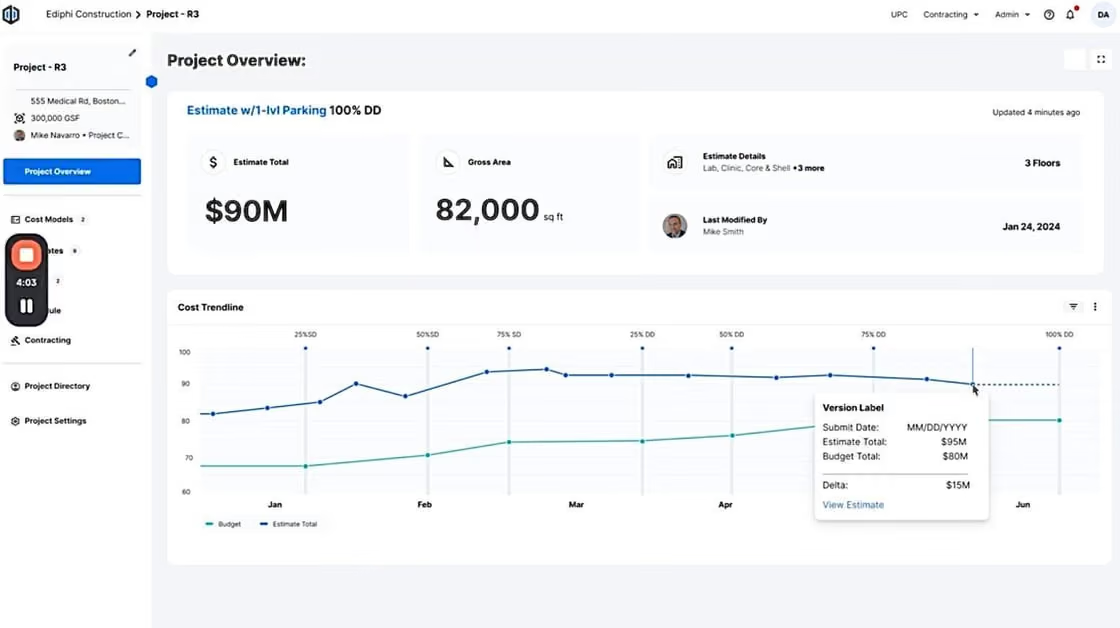
The core dysfunction: VE conversations happen outside the estimate. And it typically happens late — at 50% or 70% CDs — when the design is well-baked and the cost of change is high.
Ediphi is at work building Cost Trendlines so teams track VE options directly within the estimate 👀 Here’s a sneak peek.
Tip #5: Use AI on structured data
AI is only as good as the data feeding it.
"Garbage in, garbage out…If you don't have structured data, AI will take unstructured information and give you back really crappy results.” — Dustin DeVan, CEO at Ediphi
The poll confirmed it: the top barrier to AI adoption in preconstruction isn't skepticism about the technology — it's that data is too spread across too many systems for AI to do anything useful with it.
There’s a world where AI can answer questions like:
- What are the five lines contributing the most cost?
- What are the biggest variances from the last milestone to this one — and can you write me a narrative explaining why?
- And, have we had any VE substitutions for these product specs before?
In the webinar, Trey gave a demo of an AI agent we’re building directly into Ediphi and asked it some of these questions. We saw it return the top five cost drivers of the project (emergency generators, shoring, mid- and high-rise elevators, hoist) and reorganize the entire estimate by use group.
👉 Check it out at 46:00 of the recording.
Precon doesn’t have to take years
The throughline across all five of these ways is the same: pricing and design need to happen in parallel, not in sequence, and your data needs to live in one place to make that possible.
And the teams that are shortening preconstruction aren't doing anything exotic. They're creating stronger conception estimates, earlier, inside of tools that serve them better.
If you want a comprehensive look at how Ediphi can compress your preconstruction timeline for your organization specifically, request a demo and we’ll be in touch!

.svg)





.svg)
.svg)