



Estimating is often described as a handoff — from conceptual to detailed, from uncertainty to certainty. As if a project crosses a line where assumptions disappear and facts take over.
That moment doesn’t exist.
Information develops over time. Assumptions are made so work can move forward. Intent is interpreted long before scope is fully measurable.
The construction industry doesn’t struggle because estimating is hard. It struggles because preconstruction is treated as a single deliverable instead of an ongoing discipline.
Here’s our vision for a more complete preconstruction process.
The problem isn’t estimating, it’s incomplete preconstruction
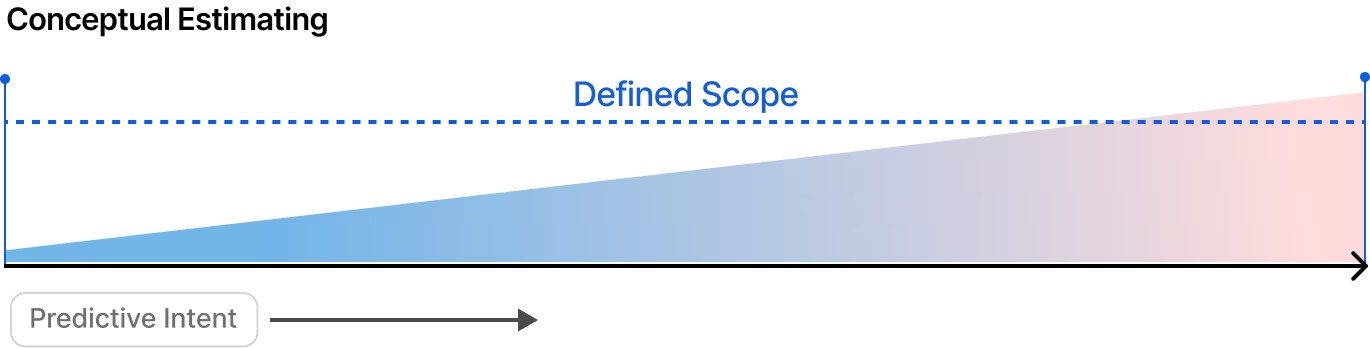
Early in a project, cost is driven by intent; what the team believes the project is, will be, and is trying to achieve. The goal for every preconstruction team is to bring this intent from conceptual estimate all the way through to defined scope.
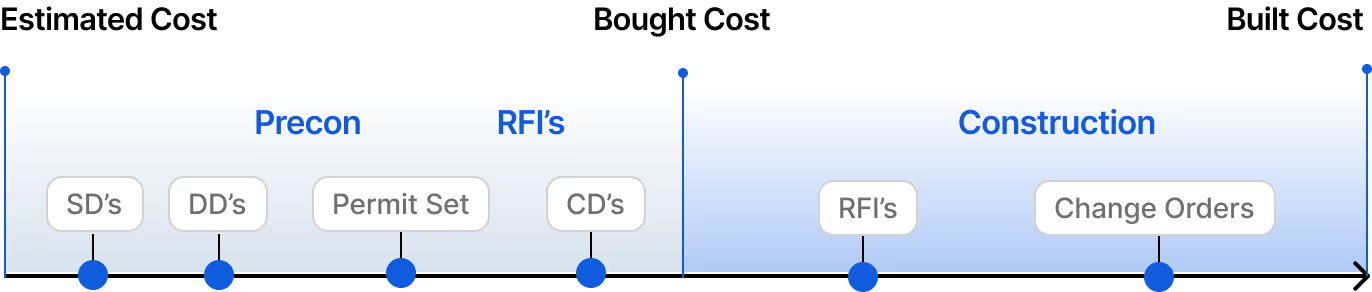
Over time, that intent becomes quantifiable, but a degree of ambiguity in the numbers never fully disappears. RFIs, change orders, and delays all happen when this ambiguity wasn’t clarified early enough.
As a result, estimated cost, bought cost, and built cost rarely align perfectly. That gap has become normalized across the industry.
The solution to better planning isn’t just “estimating better” (most teams can produce both conceptual and detailed estimates). The solution is proper preconstruction.
In other words: the deliberate, holistic effort to surface assumptions, clarify intent, test scenarios, and align stakeholders before decisions harden into scope.
The intent established in one phase needs to carry through to the next — all the way to GMP.
Proper preconstruction is about proper tech
Proper preconstruction isn’t about producing the perfect estimate. It’s about building a shared understanding across owners, designers, and builders that has the ability to evolve as information develops across the entire process.
Spreadsheets are excellent at capturing numbers, but they’re not designed to capture meaning like:
- Why a decision was made
- What assumptions were accepted
- Or which conversations shaped the cost
When teams lack a way to capture and evolve that understanding, estimates become fragile. They can look precise while being disconnected from the reasoning that produced them.
What are the tools you need to have better conversations earlier in preconstruction?
- A cloud-based database that uses past project data to help you create more accurate cost models
- Collaborative estimate environments where everyone on a project can immediately see what’s changed
- Milestones that get you get closer to target value design as those designs evolve
What impact with Ediphi looks like
Ambiguity does not disappear. But it can be confronted earlier, when it is cheaper and less disruptive.
When proper preconstruction leads the process, and intent is captured as structured information that evolves into defined scope, fewer decisions get buried, fewer assumptions get lost, and fewer surprises get pushed downstream.
That is how alignment improves between:
- Estimated cost
- Bought cost
- Built cost
Ediphi is built to support this kind of preconstruction. Not as a silver estimating bullet, but as an enabling platform that helps teams capture intent, preserve context, and evolve shared understanding as projects take shape.
The goal is not to eliminate uncertainty. It is to confront it earlier, when it is cheaper to resolve and easier to align around.
That is how better preconstruction leads to better outcomes.
If you’re interested in continuing the convo with me, let’s connect on LinkedIn
Or book a demo with my team directly to see what proper precon would look like for your org.

.svg)




.svg)
.svg)